
Trees That Changed Architecture & Wood Used in Revolutions
This is one of those episodes where woodworking stops being about tables and cabinets and starts being about civilizations. Tonight we’re talking about wood that didn’t just hold buildings up — it held ideas together. Some trees shaped how we build. Others shaped how people fought back. And like last time, the trivia questions add new information — no giveaways, no softballs.
Jess Lobdill
2/19/20264 min read
Trees That Changed Architecture & Wood Used in Revolutions
A history + material science + advanced trivia episode
This is one of those episodes where woodworking stops being about tables and cabinets and starts being about civilizations.
Tonight we’re talking about wood that didn’t just hold buildings up —
it held ideas together.
Some trees shaped how we build.
Others shaped how people fought back.
And like last time, the trivia questions add new information — no giveaways, no softballs.
PART I — 🌳 TREES THAT CHANGED ARCHITECTURE
1) 🏰
The Oak Forest of Notre-Dame
📍 Notre-Dame Cathedral — Paris, France
🌱 Species: European oak (Quercus robur)
📆 Construction: 1163–1345
Short history
The medieval roof of Notre-Dame was known as “The Forest” because it used over 1,300 oak trees, most felled while still relatively young. Each beam often came from a single tree, hewn by hand.
This wasn’t decorative oak.
This was structural faith.
Trivia 1
Why were relatively young oak trees preferred for medieval roof framing?
A) Easier transport
B) Higher sap content
C) Straighter grain with fewer internal defects
D) Faster seasoning
Why this matters:
Young oaks have straighter grain and fewer internal checks. Medieval builders understood — empirically — that wood with fewer growth stresses lasted longer under compression.
Modern parallel: Same reason timber framers still favor slow-grown, straight-grain stock.
Trivia 2
What joinery principle allowed Notre-Dame’s roof to survive 800+ years before the fire?
A) Iron fasteners
B) Redundant load paths
C) Overbuilt trusses
D) Green wood compression
Why this matters:
The roof was designed so loads redistributed naturally if one member failed. That redundancy is why ancient timber buildings outperform many modern ones.
2) 🏯
Japanese Pagodas & Earthquake Wood Science
📍 Horyu-ji — Nara, Japan
🌱 Species: Hinoki cypress (Chamaecyparis obtusa)
📆 Oldest surviving wooden buildings: 7th century
Short history
Japan has endured thousands of earthquakes — yet no five-story pagoda has ever collapsed due to seismic activity.
No steel.
No concrete.
Just wood and physics.
Trivia 3
What architectural feature allows pagodas to dissipate earthquake energy?
A) Flexible floor plates
B) Central floating column (shinbashira)
C) Low center of gravity
D) Tapered roofs
Why this matters:
The shinbashira acts like a pendulum, absorbing motion and preventing resonance. It’s shock absorption — 1,300 years before modern engineering.
Trivia 4
Why was hinoki cypress chosen for sacred structures?
A) Insect resistance
B) Aromatic oils
C) Dimensional stability and rot resistance
D) Availability
Why this matters:
Hinoki contains natural antifungal compounds and moves very little with humidity — crucial in Japan’s climate.
3) 🏛️
The Crystal Palace & the Death of Timber Dominance
📍 Crystal Palace — London, England
📆 Built: 1851
Short history
The Crystal Palace marked a turning point. It combined cast iron, glass, and wood, proving buildings could be modular, prefabricated, and mass-produced.
This was the beginning of industrial architecture — and the end of wood as the unquestioned king.
Trivia 5
What construction innovation did the Crystal Palace introduce?
A) Load-bearing glass
B) Prefabricated modular components
C) Laminated timber beams
D) Steel trusses
Why this matters:
Buildings could now be assembled like furniture kits — a direct ancestor to modern construction systems.
Trivia 6
Why was timber still critical despite iron framing?
A) Cost
B) Fire resistance
C) Thermal movement buffering
D) Ease of repair
Why this matters:
Wood absorbed expansion and contraction between rigid materials, preventing catastrophic cracking.
PART II — 🔥 WOOD USED IN REVOLUTIONS
4) 🌳
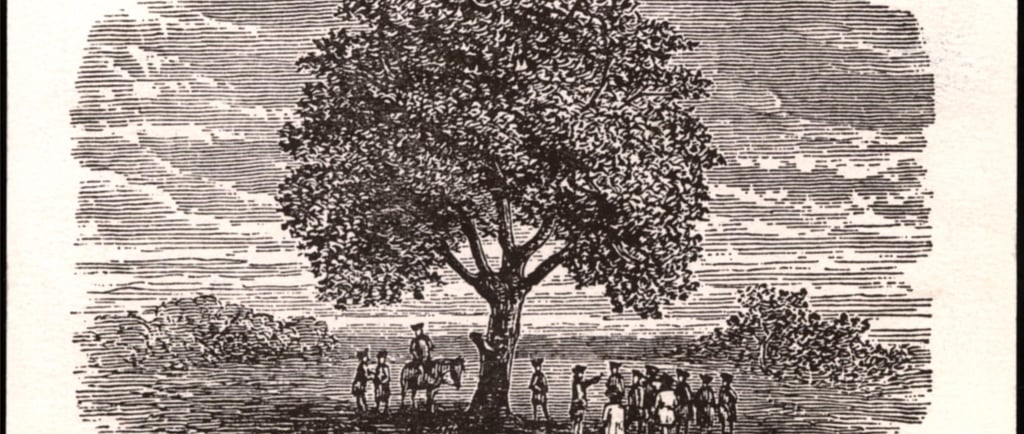
The Liberty Tree
📍 Boston Common — Massachusetts, USA
🌱 Species: American elm
📆 American Revolution: 1765–1775
Short history
The Liberty Tree became a rallying point for protests against British rule. It was eventually cut down by Loyalists — which only made it more powerful as a symbol.
Trivia 7
Why did elm trees commonly become gathering symbols?
A) Rapid growth
B) Large canopy and visibility
C) Soft carving wood
D) Sacred associations
Why this matters:
Big canopies = natural meeting halls. Trees were town squares before buildings existed.
Trivia 8
What happened to the Liberty Tree after it was cut down?
A) It was burned
B) Made into furniture
C) Turned into protest symbols
D) Buried
Why this matters:
Wood fragments became tokens of resistance — proof that materials carry meaning.
5) ⚓
White Pine & the American Mast Trade
📍 United States / United Kingdom
🌱 Species: Eastern white pine
📆 17th–18th century
Short history
Britain marked massive white pines with the King’s Broad Arrow, claiming them for naval masts — even on private land.
This fueled colonial resentment.
Trivia 9
Why was white pine ideal for ship masts?
A) Hardness
B) Height and straightness
C) Salt resistance
D) Weight
Why this matters:
Few trees on Earth grow that tall, straight, and knot-free.
Trivia 10
What law restricted colonists from using marked trees?
A) Timber Act
B) Broad Arrow Policy
C) Navigation Acts
D) Crown Reserve Law
Why this matters:
Control of wood = control of power.
6) 🌳
Liberty Trees of the French Revolution
📍 France
🌱 Species: Oak, poplar
📆 1789–1799
Short history
Revolutionaries planted liberty trees in town squares as living declarations of freedom.
Trivia 11
Why plant trees instead of monuments?
A) Cost
B) Speed
C) Living symbolism
D) Lack of stone
Why this matters:
Trees grow with the revolution — fail if ideals fail.
Trivia 12
Which woodworking lesson does this symbolism reinforce?
A) Durability matters
B) Context defines value
C) Species choice is political
D) Wood outlasts stone
Why this matters:
Wood is never neutral. It carries history, labor, and intent.
🔥 BONUS — EXTREME MODE
Bonus 1
Which architectural system most directly evolved from timber framing principles?
A) Steel moment frames
B) Post-and-beam construction
C) Reinforced concrete
D) Balloon framing
Why: Steel borrowed redundancy and load paths from timber.
Bonus 2
Which factor most determines whether wood becomes a revolutionary symbol?
A) Species
B) Strength
C) Visibility and access
D) Longevity
Why: Symbols need to be seen.
🎧 Closing Line for the Bench
Before wood held roofs,
it held ideas.
Before it framed buildings,
it framed belief systems.
And every time we mill a board,
we’re touching the same material that once
held churches up…
and empires together —
until it didn’t.
If you want next:
“Wood That Built Empires” or “Trees That Humans Couldn’t Kill.”
TRIVIA ANSWERS
1. C
2. B
3. B
4. C
5. B
6. C
7. B
8. C
9. B
10. B
11. C
12. B
Bonus 1: A
Bonus 2: C